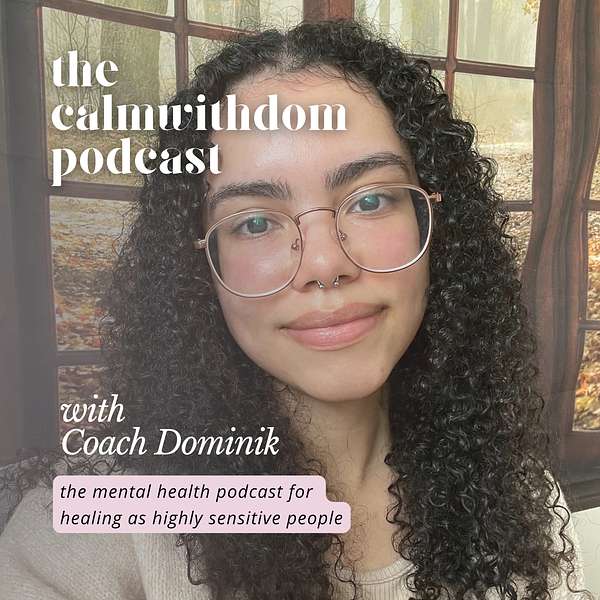
The CalmWithDom Podcast
Hey I'm Dominik, an Emotional Intelligence Coach for highly sensitive women ready to break their cycles of overwhelm to cultivate stronger relationships (both with themselves and others).
On this show, we do deep dives into how to best understand and leverage your sensitivity to thrive with tools such as shadow work, emotional intelligence skills, and more. My approach is psychospiritual because I truly believe we work best with all the language we can.
We're letting go of overwhelm and stepping into an unshakeable love of self over here, so I'm glad you've joined us!
From my sensitive soul to yours, I hope this helps.
The CalmWithDom Podcast
How Highly Sensitive Women Can Be Their NEW Selves In OLD Stories: The Power Of Reframing Negative Memories
We can be so diligent with our own self-transformations that we neglect the transforming of the old stories we've existed in.
What does this mean? All the people who have impacted us, for better or worse, gets leftbehind in our rewriting of our "life scripts." And while that doesn't sound like a bad thing in retrospect, it's bites us in the butt when we're faced with old, triggering stories or the same people who trigger us the same exact way Pre-Self Transformation.
This is where reframing our negative memories holds IMPACT. Let's dig into what this looks like in practice, and how it's going to help you be comfortable being uncomfortable, sensitive soul.
With love, I hope this helps🌷
Mentioned In Episode:
IG Broadcast Channel "🌷Raw Downloads with Dom🌷"
Podcast Ep. "What You MUST Know About Receiving Criticism As An HSP" (YouTube Vid)
Podcast Ep. "What You MUST Know About Receiving Criticism As An HSP" (Audio)
How To Get Better At Receiving Criticism (Blog Post)
Here's How I Serve👇🏽
FREE:
For proactive pattern-interrupting during times of overstimulation: Grab your Free Emotional Intelligence Self-Reflection Workbook here💙
PAID:
Click HERE to learn how to become deeply grounded in yourself as a highly sensitive, highly intuitive woman by learning how to protect your energy effectively.
Apply To Work With Me 1:1! For those of you ready to embody your sensitivity for relationships that fuel you (with me as your guide in your back pocket).
Leaving a rating and review is how you directly support the show - and how your comment can be included in an episode!
Go for it, sensitive soul - I can't wait to connect with you.
MORE INFO:
Website: www.calmwithdom.com
Instagram: @calmwithdom
Read The Blog: https://calmwithdom.com/blog/
Email Me: dominik@calmwithdom.com
Hello and welcome to the Calm with Dom Podcast, where I help you harness your highly sensitive nature to overcome your energy leaks and strengthen your relationship with yourself and others. I am your coach Dominic. Today we're talking about reframing negative memories. Is it possible? Why do HSPs um benefit more from that process? And what does that even look like? Why try to do it? I want to dive straight into this. So thanks for being here and let's get into it. So is reframing negative memories possible? You know, it's not very intuitive to think so. When we get to a point in our journeys where we realize that it's that it's possible that even this we have control over and authority over in the in the reshaping and the transforming of our lives, it changes the game in your journey to harnessing your sensitivity for the better, right? To serve you versus cripple you. There's no secret to it, right? Whenever we try to understand our selves, our foundations, the people in our lives, how they impacted us, uh, doing all the personal development stuff, doing all of the shadow work, doing all the inner work in therapy and counseling and coaching sessions. Our core memories are actually getting reframed naturally. That's the natural byproduct of this process, which is beautiful. We're simply looking at them through a different lens, a newer perspective, a hopefully wiser perspective as we continue to evolve. So what's the problem, you may be asking? Uh, the problem that I see highly sensitive women that I speak to and work with face is when they decide to, you know, go deeper in their self-transformation, as in deciding to relate to themselves differently, they will continue to subscribe to old or limiting stories about the people in their lives, whether the people in their past or the people currently that they're in relationship with. That's the problem. And before I get ahead of myself, if you are not familiar with my work, I help highly sensitive women strengthen their relationships. A part of doing that has to look like working with them in real time, right? It's the more difficult part of getting grounded in your sensitivity. So I find that highly sensitive people will avoid that altogether, of course, until they work with me. And then I'm like, no, no, no. We are we are working in and on your relationships. Okay. And of course, it's scarier to do. You can't control how other people think and act and how they treat you and how they receive and perceive you. There's there's only so much you can do, it's ultimately up to them, and it's uh their view of you is a reflection of their relationship with themselves. And that lack of control, especially when you're on the journey of proclaiming and reclaiming your authority in your life and your own power and what you do have control over it, that's a scarier problem to face. When you have crappy experiences with the people of your past and are faced with new crappy experiences with new faces, you're dealing with stories that your child self created. Okay, you cannot update your life script, so to speak, without updating those old stories because then you're not going to operate as your new self in those stories when they come up again. Okay, your new self doesn't exist in those old stories yet. Reframing your negative memories is what allows that to finally happen. I like to reference the concept of time, which is understood loosely, generally, in the timeline of past, present, future. In reality, going more in the order of future, present, and then past, it indicates, for me at least, which is why I even bothered to bring it up, that maybe the future is already set. While the present is not only the becoming of your future, but the rewriting of your past, which is why I put past last in that new, newer timeline. Not that I made that up myself. Um, I'm sure that's something that's a concept that a lot of people subscribe to. It's definitely more exciting, it's definitely more fun and expansive. I just know for myself when I consider it that way and try it on for size, then reframing my negative memories is a crystal clear option to healing. The point of the episode is to let you in in a couple of different ways to come to this reframing and the true extent of the healing that can happen for you if you try it for yourself. That's just how it shows up for me when I consider this concept of time. So I wanted to like throw that at you, see if you would like to try that on for size as you approach this. So highly sensitive people benefit from this approach for a couple of different reasons. Firstly, you are way more impacted by negative experiences than other people, which may mean that you have to exert more effort to avoid being traumatized by negative experiences, as well as in the healing of the painful experiences than other than other people. It's overall it's a very draining process. You gotta try harder to avoid becoming traumatized, and you've got to try harder to heal, right? You're exerting more energy in the healing process of it, right? Getting yourself out of that than others. So that's the first reason. Reframing a negative memory is what's gonna be vital for you to stop the past from actively hindering your present. Okay. Second reason, because you benefit so much more from positivity in learning how to reframe your negative memories, your sensitivity provides you a greater advantage in that what you healed and learned within yourself can actively be used day to day. Your compassion for other people will grow as a result because you empathize deeply anyway, versus get stuck in a mindset where you're cursing people and you're cursing yourself out of hurt and resentment without necessarily realizing it. And I'm gonna talk about this for a minute. What do I mean by cursing yourself and cursing others? This is something I see highly sensitive women do all the time, and they're very loud about it. And I know that it's coming from a place of hurt and resentment, and they are not realizing that they are cursing themselves with their own words and their own mindset. You cursing yourself can look like accepting life as a shut-in with minimal contact with the outside world. Unless you're being obedient to God and your current season, you don't want to count yourself out of the process of becoming. The world and the people in it have all types of intentions, but it's in no way good for your soul to be avoiding the very lessons you need to grow through to become what the world needs you to be. And I know that sounds big, but sometimes that just looks like you needing to be the person to put a smile on someone else's face who's given up on a specific day. The person a family member needs to learn their own lessons, the person to donate a couple of dollars to get projects in motion, the person to show up at an event and change someone else's posture because what you offer your environment is truly different as a highly sensitive person. You need to show up and participate in some capacity, especially now more than ever. If you follow me on socials, you know I'm not big on pressuring highly sensitive people, highly sensitive women in particular, to make sure that you're completely up to date with what's going on with every single atrocity that comes to light to push the highly sensitive woman to do something about it. Do something about it, like be loud online. Because truthfully, you being loud online doesn't mean that you're doing something about it. And even you sharing doesn't necessarily mean that you're doing something about it. It may feel that way. I think it's the easiest way to feel like you're being productive and proactive, but it's absolutely a lie that we have sold ourselves for the bare minimum. Your energy, it is crucial, it is vital, it is important, it is currency. It is true currency and holds weight in this world. And I don't care what anyone else has to say about it, but truly, truly. So do not mistake this message as some sort of push to make sure that you're like getting up and doing all the things to be the next social justice warrior. I'm talking about true intentional action, which is putting yourself out there and having the conversations you need to have, honoring your energy and the spaces you need to occupy, wherever you're called to be, whether it is fueling you, as in you're in that room, you're in that space, fueling and lighting a fire in people. Sometimes just by being there and not saying a word, or it is refueling you, and you are gaining energy. Your attention and your energy, it is currency, and that's what I mean. When you curse yourself, you are not allowing yourself to show up in the ways that your energy needs you to as a highly sensitive person. Now, I also see highly sensitive women cursing others, and it kind of looks the same exact way, just inverse. You cursing other people can look like denying others the option and opportunities to grow as well. You've got to go out there and disappoint people and be disappointed by people. I recently spoke about this on my stories and on the broadcast channel on Instagram. If that is a place that you like to be and you'd like to join that space, I feel free to do so. The link will be in the show notes to join the little but growing family that we have there. I recently spoke about how right now highly sensitive women need to be taking up space and they are resisting it in order to prevent being heartbroken by people again. It is not easy, but it is promised. You've got to be open to being heartbroken again, to being disappointed by people again. You have got to be open to disappointing people and not being the perfect caregiver, nurturer that maybe people have kind of put you in a position to be or painted you as. Even if you, you know, hold those titles with pride, that is not all that you are. And you've got to disappoint people. That is a gift as well that you give to other people when you show up. You've got to be someone's pride and joy by being your authentic self. You've got to bring to others new life and new energy from the books you've been living in for who knows how many months, years, right? Because if you're not extracting from all of the places that you uh, you know, get lost in, that you bask in, all of the imaginary worlds, all of the real life worlds, the little the rabbit holes that you fall in, if you are not extracting from the places and the people and the things and the stories that fuel you, and then not injecting that new energy that has stirred in you into other places so other people can can touch and taste and feel and see and perceive the the joy and the wisdom and the lessons that you have been accumulating. Other people are missing you. People who do not even know you, that don't even know that they're missing you, are missing you. And that's what I mean by cursing others and cursing yourself, by making the decision to opt out for the sake of your sensitivity, opting out, going into hermit mode, um, deciding no thanks, I can't handle that. I'm not a huge proponent of tough love. I'm a huge proponent of kind of being clear and direct about the power that you hold in the spaces you occupy as a highly sensitive woman, so that you fully understand your impact. Reframing your negative memories can give you your autonomy back. As a result, forgiveness becomes much more accessible, right, for yourself and for the people that you are doing life with. And even that, right, that ease, um, that access makes creating your version of peace that much more attainable. And I want to highlight in this episode that reframing your negative memories is not a coping skill. I'm not giving you a coping skill so that you can just manage day to day. You are actively doing shadow work with this process. It's just one of the many ways to do so. It's intensive and it's ongoing. So it's not something that you're going to always completely quote unquote accomplish and check off your to-do list. Okay. This is the kind of work that's going to make your sensitivity work for you long term. So, how do you reframe your negative memories, especially through relational work, right? In your relationships, how does that work? The reframing looks like going through a pivotal negative memory for you. Whether that happened last week or 10 years ago, you are going to look back at those pivotal negative memories with curiosity. In this case, curiosity does not mean that you are seeking answers about said memory. I'm sure you've already gone over this negative memory and did just that. It's everyone's desire to be mind readers so that you can know for sure where the other person is coming from. And it's that kind of confusion that leads us to this path. It allows us to create stories in the first place. This time around, you're not getting curious about um, why did this person do this? Why did they say that to me? How could they have done that? You're not creating stories when you're reframing your negative memory. You are getting curious about yourself in that negative memory. You're questioning the story you created in the first place. You're not playing into the story again and spiraling in that same trap of confusion and heated emotions. Think back if it was a weird conversation with a partner, um, a misunderstanding at work, a hurtful uh memory with a family member. What happened? What did so-and-so say and do, and what did it mean to you in the moment? We do a lot of reacting when we're in the thick of it or in the middle of it, but reacting becomes responding when we ask ourselves these kinds of questions in real time. Your seven-year-old self, your 10-year-old self, your 18-year-old self, even your 25-year-old self probably wasn't good at asking these kinds of questions. You may be good at asking yourself these questions right now, but you may not be good at doing so in the middle of conflict. I'm certainly not. I'm only improving that skill every day, but I'm not perfect at this. This is a tool that sharpens you over time. Eventually, you may be good at even communicating your answers to these questions in real time to your person and having that open dialogue. That's going to be the moment that you operate as your new self in the midst of old stories. Like that, you get to rewrite those stories. Now, I want to talk about what our bodies remember. There is a very conscious way of reframing your negative memories, which I just discussed, but there's also an unconscious way of reframing those negative memories. The unconscious way almost requires us to actively put on the new perspective we've acquired through our shadow work to now train our physical bodies to recognize new patterns. Our physical bodies love repetition. It's what establishes safety. That process is just us teaching our bodies that this new habit is safe, whether it actually is or not. And this is where desensitization comes in. You have to be willing to put yourself in the scenarios where the old stories would play out so that you can practice being your upgraded self in them. Think about it like this: you are writing this new character into this new reframed story, right? You're injecting new energy into this boring story that's too safe and too familiar to you. And it's like exposure therapy for your sensitivity. It's also harder than it sounds. And doing something new usually means you're not gonna be good at it the first time. That's why I advise my clients to reach out to those old faces that hold a lot of power over them today. It's hard, it's scary. I find that in our time together within a coaching container, it's the perfect time to do those hard and scary things because they're not doing it alone. Like I said earlier in the episode about cursing yourself and other people, you need to make sure that the commitment to show up in better ways is strong, even when you're failing at it. That's why the episode of how to receive criticism as a highly sensitive person is really helpful in this process. So that'll be that'll pop up if you're watching the video of this podcast episode, but it'll be linked below. We know and we want better for ourselves, but we can also placate ourselves into believing that the wanting of it is enough to see change. Changing your mindset will absolutely change your posture immediately. I don't want to get that twisted. Changing your mind does change your life eventually, but it is continuing to show up and try that's gonna get you to fail forward in your practice of embodying your sensitivity. That's the work we do in the one-on-one embodiment container. We're doing relationship work in real time. This episode was just an example of the type of coaching that you'll receive every week for three to six months with me. So if you're ready, if you're ready to do this kind of work under the guidance of someone who's done this work, who's walked several highly sensitive women through the same kind of work and who's done this work herself, the application to apply to work with me one-on-one will be linked in the show notes as well. To recap, reframing negative memories looks like revisiting them, getting curious about how you took it the first time, and making sure that you're updating those old stories that in the moment you created about those people, making sure that those stories get updated, and if not consciously, right, by the literal reframing of the story, unconsciously through the physical, by showing up as your upgraded self, facing the same situations, the same characters, the same stories in a new way. That's how you rewrite the stories, okay? You don't need the other person, but sometimes we have to do the actual work with the people who affected us. There have been so many times that I've seen this pattern of working with women who come to a point in their life where they kind of feel like they're living a deja vu where their life kind of looks the same way it looked 10 years ago or 20 years ago, but they're different. And I always say that there is a closing of a cycle that they are starting and finishing, right? They are rewriting this story, they get to tell it and they get to do it the way that they want to this time, a way that is way more authentic and that honors their sensitivity. So it's really interesting. It's what inspired this episode. It's super important work. So I hope that it was helpful. Share your thoughts in the comments. Thank you for joining me this week. And if there's any questions, if you want to share your own stories, you can absolutely text me. You can text me, you can email me, you can send me a message on socials. And right about here is where my audio cut off. So I was gonna say, you can find the links to text me, to message me on socials, um, to reach out, to check out other resources that may help you. Those are all gonna be linked in the show notes and the description box if you're watching this episode on YouTube. Thank you so much for being with me here, and I'll see you next week.
Podcasts we love
Check out these other fine podcasts recommended by us, not an algorithm.

